


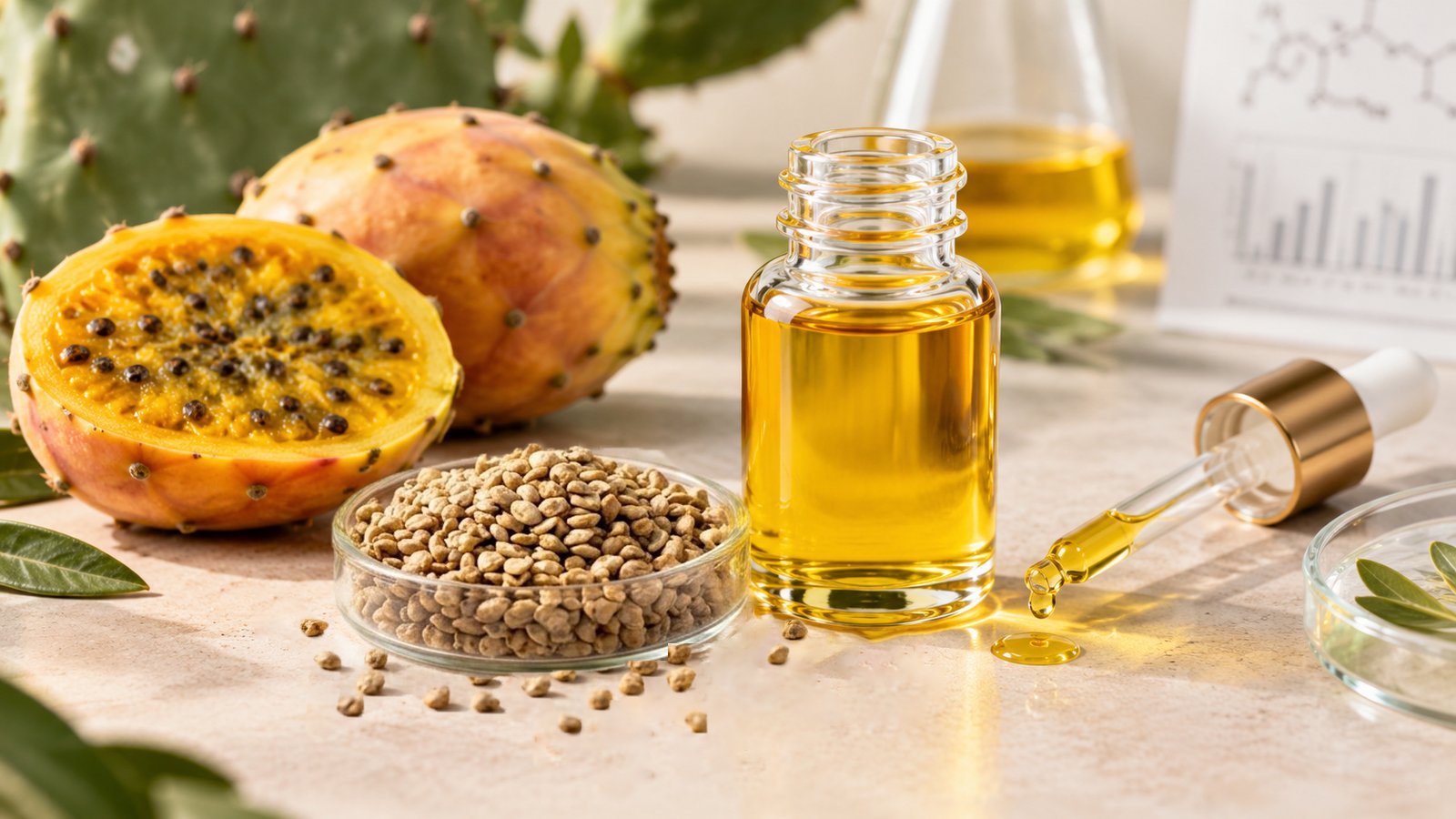
Prickly Pear Seed Oil Composition: What Scientific Research Reveals
Prickly pear seed oil has gained attention in the natural cosmetics industry for its distinctive composition and its potential applications in premium skincare formulations. Extracted from the seeds of Opuntia ficus-indica, a cactus widely cultivated in Morocco, this botanical oil contains a range of fatty acids and valuable active ingredients that attract significant scientific interest.
But what does scientific research reveal about prickly pear seed oil composition? Which compounds have been identified, how do extraction methods affect its composition, and what can these findings mean for cosmetic formulators?
This article reviews published scientific studies to determine the chemical composition of prickly pear seed oil, with particular attention to research on Moroccan samples.
To learn more about its cosmetic benefits and applications, read our article on prickly pear seed oil benefits and uses.
1. What Is Prickly Pear Seed Oil?
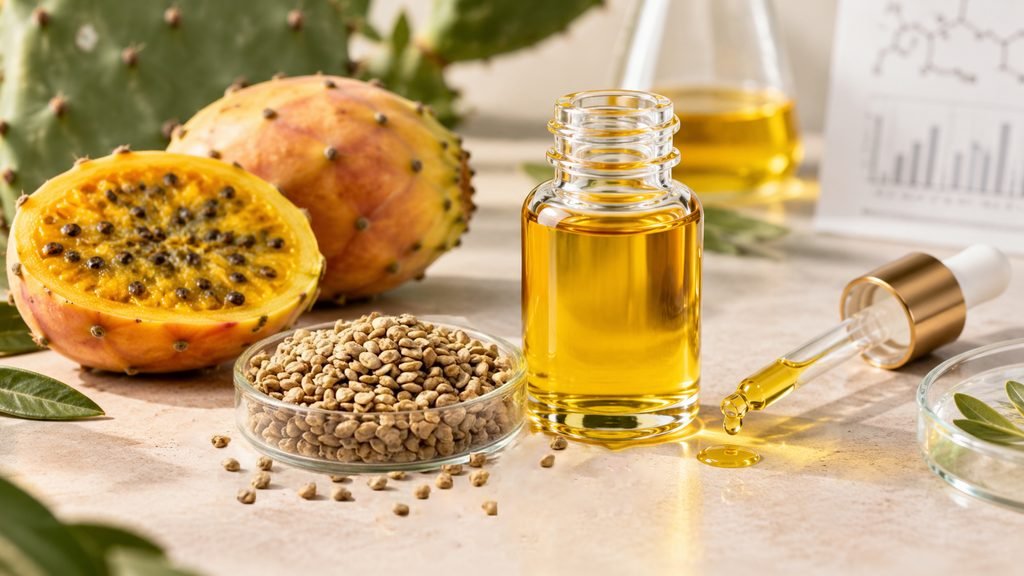
Prickly pear seed oil, also known as cactus pear seed oil, is a vegetable oil obtained from the small seeds of the prickly pear fruit. Its botanical name is Opuntia ficus-indica.
The oil is valued as a specialty cosmetic ingredient because extracting it requires processing a large quantity of seeds.
Unlike oils obtained from the fruit pulp, prickly pear seed oil comes specifically from the seeds. This distinction matters because the oil has its own characteristic fatty acid profile and contains compounds such as tocopherols and phytosterols.
Its composition makes it an interesting ingredient for cosmetic manufacturers developing:
- Facial oils and serums
- Moisturizing formulations
- Other premium oil-based skincare products.
To learn more about its cosmetic benefits and applications, explore our Moroccan prickly pear seed oil.
For professional buyers, our Premium product is is available for cosmetic sourcing enquiries.
2. Fatty Acid Composition: Why Linoleic Acid Matters
One of the most studied characteristics of prickly pear seed oil is its fatty acid profile.
Fatty acids are important components of vegetable oils. Their relative proportions influence an oil’s chemical properties, oxidative stability, and suitability for different cosmetic applications.
Research on prickly pear seed oil has consistently identified linoleic acid as one of its principal fatty acids. Its exact proportion varies between various studies and samples.
Linoleic acid
Linoleic acid is an omega-6 polyunsaturated fatty acid. It is an essential fatty acid and an important component of the skin’s lipid barrier.
In topical skincare, linoleic acid matters because the skin barrier relies on an organized mixture of lipids to maintain integrity and limit excessive water loss.
Linoleic acid makes prickly pear seed oil an interesting ingredient for cosmetic formulations designed to support skin softness and maintain the skin’s lipid balance.
Oleic and palmitic acids
Oleic acid, a monounsaturated fatty acid, is another component identified in prickly pear seed oil. Palmitic acid, a saturated fatty acid, is also present.
Together, these fatty acids contribute to the oil’s overall composition and help distinguish it from other botanical oils.
What did researchers find in this Moroccan oil?
A study by Kadda and colleagues, published in Environmental Science and Pollution Research, examined prickly pear seeds collected in eastern Morocco.
The researchers reported linoleic acid proportions of around 71.6% for mechanically extracted oil, 74.1% by maceration, and 75.8% for chemically extracted oil.
These findings highlight the predominance of linoleic acid in the samples studied. They should not be treated as universal specifications for every prickly pear seed oil.
Scientific source: Kadda et al. — Temperature and extraction methods effects on prickly pear seed oil
3. Tocopherols: Compounds With Antioxidant Activity
Another important group of compounds identified in prickly pear seed oil is the tocopherols, members of the vitamin E family.
Tocopherols are lipid-soluble compounds known for their antioxidant activity. In oils, they can help limit oxidative reactions, although their effectiveness depends on the oil’s composition, storage conditions, and other factors.
Gamma-tocopherol
The Moroccan study by Kadda and colleagues reported gamma-tocopherol as a major tocopherol in the samples analyzed.
In mechanically extracted oil, the researchers measured approximately 502 mg/kg of gamma-tocopherol. In other extraction methods tested, its value was lower.
These findings highlight how extraction methods affect the natural tocopherol content of prickly pear seed oil, making extraction conditions an important consideration when evaluating its composition and quality.
Tocopherols are of interest to cosmetic formulators for two main reasons:
- They contribute to an antioxidant oil’s profile.
- They may help protect susceptible lipids against oxidation, depending on the formulation and storage conditions.
An oil’s natural tocopherol content should not be confused with a guarantee of shelf life. Oxidative stability also depends on fatty acid composition, exposure to light and oxygen, temperature, packaging, and handling.
For manufacturers, analytical testing is the best way to establish the specific batch’s composition and quality.
4. Phenolic Compounds and Antioxidant Research
Beyond fatty acids and tocopherols, researchers have investigated phenolic compounds associated with prickly pear seed oil and its extracts.
Phenolic compounds form a broad family of substances studied for their potential antioxidant properties. Their presence and concentration depend on the sample and the analytical method used.
In 2022, a study published in the Journal of Pharmacopunctin examined the fatty acids, tocopherols, and phenolic compounds of cactus pear seed oil. The researchers also tested the antioxidant activity of a phenolic-rich fraction using laboratory assays.
These findings highlight the scientific interest of prickly pear seed oil and its naturally occurring compounds for premium cosmetic formulations.
Scientific source: Chemical Composition of Cactus Pear Seed Oil: Phenolics Identification and Antioxidant Activity (2022)
5. How Extraction Methods Affect Oil Composition
A vegetable species alone does not determine botanical oil composition. Extraction methods and processing conditions can also influence the resulting oil.
Prickly pear seed oil may be obtained through mechanical pressing, solvent-based extraction, or other processing techniques. Each method has its own characteristics in terms of yield, processing requirements, and the compounds recovered.
In the Moroccan study mentioned earlier, researchers compared mechanical extraction, chemical extraction, and maceration.
They reported oil yields of approximately 12.49%, 11.46%, and 10.52%, respectively, under their experimental conditions.
The researchers also observed differences in the measured fatty acid and gamma-tocopherol levels between extraction methods.
These results demonstrate why comparisons between oils should consider the production process and the analytical data rather than relying on the botanical name alone.
For cosmetic manufacturers, relevant quality considerations may include:
- The extraction method and processing conditions.
- The fatty acid profile.
- The tocopherol content, when relevant to the product specification.
- Acid value and peroxide value.
- Batch consistency, storage conditions, and traceability.
The most appropriate specifications depend on the intended application and the finished cosmetic product’s requirements.
6. What Does Science Actually Reveal About Prickly Pear Seed Oil Composition?
Scientific research provides useful information about the prickly pear seed oil’s composition.
It contains unsaturated fatty acids, naturally occurring tocopherols, and other compounds of scientific interest.
What research supports:
- In many samples studied, Prickly pear seed oil contains a high proportion of unsaturated fatty acids, particularly linoleic acid.
- Researchers have detected tocopherols in this oil.
- Laboratory studies have investigated its antioxidant activity and its phenolic-rich fractions.
- Extraction methods can affect oil yield and some measured compositional characteristics.
These findings help explain why prickly pear seed oil attracts interest as a specialty ingredient in premium skincare. Understanding its composition helps cosmetic manufacturers make informed sourcing decisions and develop formulations that maximize the oil’s distinctive characteristics.
For cosmetic brands, the scientific accuracy supports responsible product development and credible communication with customers.
7. Why Its Composition Matters to Cosmetic Manufacturers
Prickly pear seed oil is an interesting specialty ingredient for brands seeking botanical oils with a distinctive composition and a clear origin story.
Its fatty acid profile, tocopherol content, and potential applications make it an ideal ingredient for developing premium facial oils, serums, moisturizing products, and other oil-based formulations.
For manufacturers and product developers, selecting an ingredient involves more than reviewing general information about a plant. They may also need to evaluate the supplier’s technical documentation, product specifications, traceability, and batch quality.
The high value of oil as a cosmetic ingredient stems from the resources required to obtain its seeds. This makes sourcing, production consistency, and appropriate handling important considerations for professional buyers.
8. Conclusion: A Botanical Oil Worth Studying
Prickly pear seed oil offers a good example of how scientific research can explain the botanical ingredient’s value.
Studies have characterized its fatty acids, identified tocopherols, and investigated antioxidant activity under laboratory conditions. Research on samples from eastern Morocco has also demonstrated that extraction methods can influence oil yield and measured composition.
These findings support continued interest in prickly pear seed oil as a specialty cosmetic ingredient.
Scientific References
- Kadda, S. et al. (2022). Temperature and extraction methods effects on yields, fatty acids, and tocopherols of prickly pear (Opuntia ficus-indica L.) seed oil of eastern region of Morocco. Environmental Science and Pollution Research, 29, 158–166. Read the study on PubMed.
- Chemical Composition of Cactus Pear Seed Oil: Phenolics Identification and Antioxidant Activity. Journal of Pharmacopuncture, 25(2), 121–129 (2022). Read the open-access study.
- Prickly Pear Seed Oil Extraction, Chemical Characterization and Potential Health Benefits. Molecules, 26(16), 5018 (2021). Read the review.